Overview
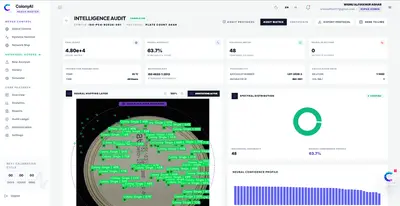
AI-powered Automated Plate Count Reader for microbiology laboratories — official entry for AI Open Innovation Challenge 2026 (team of 4 from President University, Wisnu as Product Owner & Software Engineer). Fine-tuned YOLOv8 model achieving 94.1% mAP@0.5, 94.7% precision, 92.5% recall across 56,124 annotations. Converts agar plate images into CFU/ml reports in under 2 minutes — reducing inter-analyst variability by 92.5%. Features CLAHE preprocessing, Hough Circle detection, SA-001 merged colony estimation, GUM uncertainty, SHA-256 audit trail for ISO 17025, BPOM & SNI compliance. Enterprise-grade security: Argon2 hashing, JWT blacklisting, ClamAV scanning, Zero-Trust architecture.
The Problem
Microbiology laboratories face a critical bottleneck: bacterial colony counting on agar plates is performed manually by analysts. This process is extremely time-consuming and suffers from high inter-analyst variability — coefficient of variation ranges from 22.7% to 80% depending on plate complexity. This inconsistency leads to unreliable CFU/ml calculations, compromised quality control, and potential food safety risks. Traditional automated solutions are either too expensive or lack the accuracy required for regulatory compliance with ISO 17025 standards.
The Solution
ColonyAI is a deep learning-powered automated system that integrates a computer vision pipeline with a secure web dashboard. The system uses a fine-tuned YOLOv8 neural network optimized to detect and classify objects into 5 distinct classes (colony_single, colony_merged, bubble, dust_debris, media_crack). Preprocessing is accelerated using Contrast Limited Adaptive Histogram Equalization (CLAHE) and Hough Circle Transform to automatically isolate the agar plate area. The system achieves 94.1% mAP@0.5, 94.7% precision, and 92.5% recall across 56,124 bounding box annotations, reducing inter-analyst variability by 92.5%.
Key Features
Computer Vision Pipeline
Fine-tuned YOLOv8s neural network optimized for 5-class detection (colony_single, colony_merged, bubble, dust_debris, media_crack). Preprocessing uses CLAHE for contrast enhancement and Hough Circle Transform for automatic agar plate localization.
Artifact Rejection System
Differentiates valid biological colonies from non-biological noise (air bubbles, dust particles, media cracks) with over 90% artifact rejection precision, preventing false positives in final colony counts.
Scientific CFU/ml Calculations
Automatically calculates Colony Forming Units per milliliter based on dilution factor and volume plated. Includes SA-001 area-based merged colony estimation for overlapping colonies and expanded measurement uncertainty (k=2) per ISO/IEC Guide 98-3 (GUM).
Cryptographic Audit Trail
ISO 17025-compliant tamper-evident database logging using SHA-256 cryptographic hash chaining. Any unauthorized modification to past logs automatically invalidates the subsequent chain, making data tampering detectable.
Enterprise-Grade Security
Zero-Trust architecture with Argon2 password hashing, JWT with JTI-based blacklisting for instant session revocation, magic-bytes verification to prevent MIME-type spoofing, automatic EXIF metadata stripping for GPS privacy, and integrated ClamAV malware scanning.
Multi-Role Governance
4-tier Role-Based Access Control (RBAC) — Admin, Manager, Analyst, and Auditor — enforcing strict separation of duties within the laboratory workflow.
Architecture
Frontend: Next.js 14 (App Router) with TypeScript, Tailwind CSS, and Zustand state management. Backend: Python FastAPI with Pydantic v2 validation and SQLAlchemy 2.0 Async ORM. AI/ML: YOLOv8s model via PyTorch and OpenCV. Database: PostgreSQL 15 (ACID-compliant). Infrastructure: Docker containers deployed on Railway (backend) and Vercel (frontend) with AWS S3 (AES-256 encrypted) for image storage.
How to Use
Upload agar plate images through the web dashboard (colonyai-eta.vercel.app). The system automatically processes the image through CLAHE preprocessing, detects the agar plate boundary using Hough Circle Transform, runs the YOLOv8 inference engine, and generates a standardized CFU/ml report in under 2 minutes. Users can review detected colonies, accept or reject auto-classifications, and export results as PDF (BPOM/SNI compliant) or CSV. The system supports batch processing for multiple plates simultaneously.
Impact & Results
Transforms microbiology laboratory workflows by reducing colony counting time from 15-30 minutes per plate to under 2 minutes — a 90%+ reduction in analysis time. Inter-analyst variability dropped from 22.7-80% CV to near-zero consistency. The SA-001 area-based merged colony estimation algorithm accurately handles overlapping colonies that would stump traditional thresholding methods. The SHA-256 cryptographic hash chaining audit trail ensures ISO 17025 compliance with tamper-evident logging. Artifact rejection precision exceeds 90%, preventing false positives from bubbles, dust, and media cracks. The system was officially submitted to the AI Open Innovation Challenge 2026 by Team President University.